Implant, bridge or denture: which is the right way to replace a tooth?+ the “Am I a candidate for implants?” test
Take the free test · 1 minPublished on 1 October 2026 · Dr. Reda Saoui · 5 min read
Free test · ≈ 1 min
Am I a candidate for dental implants?
6 questions, 1 minute. Get a first assessment and the solution most likely to suit your situation.
Your result
Most likely solution
Good to know for your case
This test gives general guidance and does not replace a clinical and X-ray examination. Only a consultation at the clinic can confirm the indication.
Losing a tooth is more than a gap in your smile. In the months that follow, the bone that held the root starts to shrink, neighbouring teeth can drift, and chewing shifts onto the rest of your mouth. The good news: there are three main ways to replace a tooth today, and each one has its place.
In this guide, Dr. Reda Saoui gives an honest comparison of the implant, the bridge and the removable denture, answers the questions patients ask most often before deciding, and helps you find out whether you are a candidate. Start with the test above to see where you stand, then read the full guide.
The comparison at a glance
| Implant + crown | Bridge | Removable denture | |
|---|---|---|---|
| Fixed? | Yes | Yes | No, it comes out |
| Affects neighbouring teeth? | No | Yes, they are filed down to support it | Slightly (support clasps) |
| Preserves bone? | Yes, the artificial root stimulates the bone | No | No, bone keeps shrinking |
| Typical lifespan | 20+ years for the implant (the crown can be renewed) | 10–15 years | 5–8 years, with adjustments |
| How it feels | Close to a natural tooth | Good | Less stable, can affect speech and eating |
| Upfront investment | Highest | Medium | Lowest |
| Treatment time | 3–6 months (healing) | 2–3 weeks | 2–4 weeks |
These are averages: your own situation (neighbouring teeth, bone volume, general health) can tip the balance.
When is each option the right choice?
The implant: the reference solution when it is possible
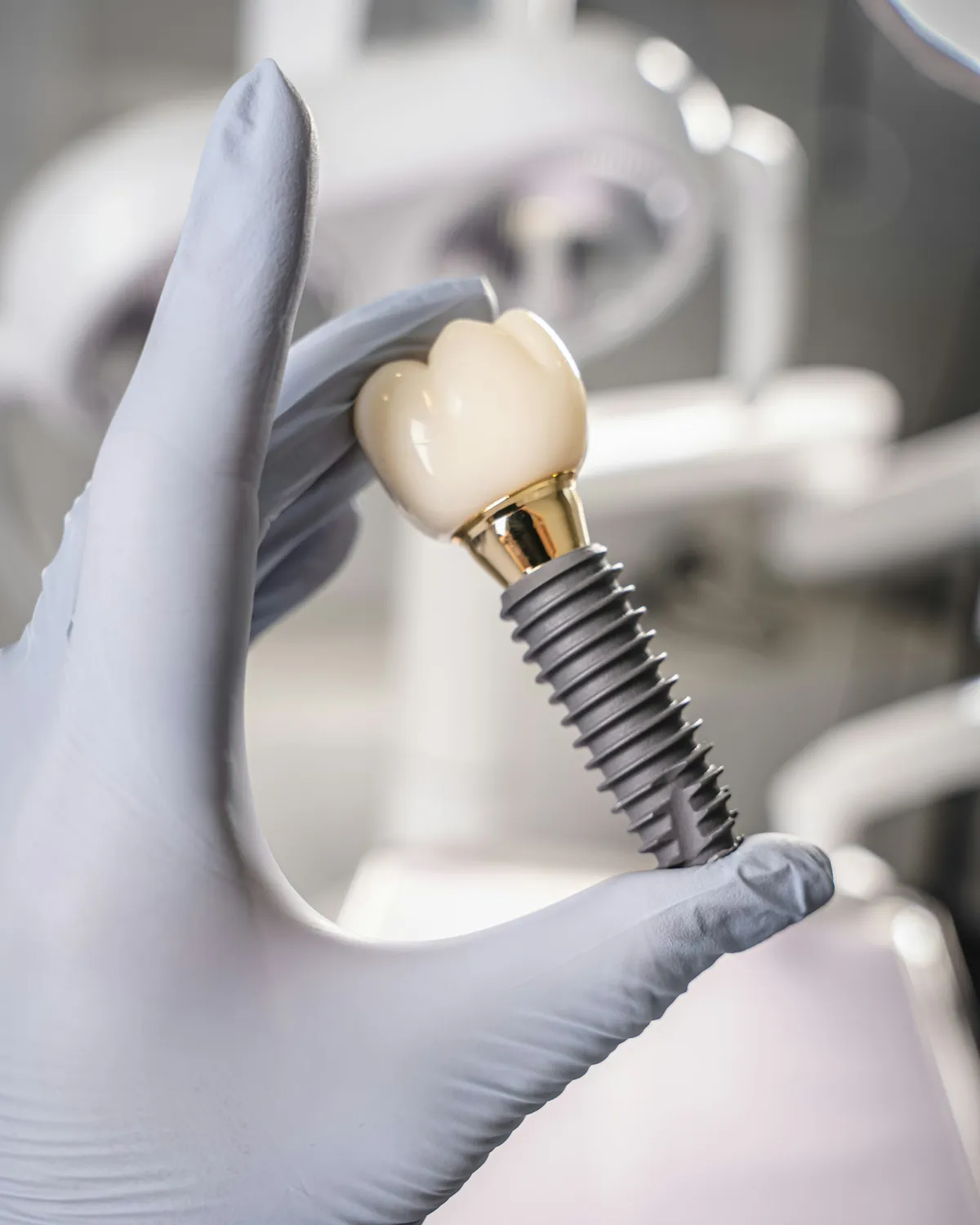
A dental implant is a small titanium root placed in the jawbone, topped with a crown. It is the only option that replaces both the root and the tooth. It is especially suited if:
- your neighbouring teeth are healthy and you do not want them filed down;
- you want a fixed, long-term solution;
- you want to slow down bone loss, especially at the front of the mouth where it shows on the face.
For several missing teeth, two implants can carry a three-tooth bridge. For a whole jaw, 4 to 6 implants are enough to fix a full arch.
The bridge: useful when the neighbouring teeth already need crowns
A bridge is a span of crowns bonded onto the two teeth on either side of the gap. It makes sense when those teeth are already heavily restored or damaged: crowning them protects them at the same time. Filing down two healthy teeth to replace one, however, is a trade-off we avoid when an implant is possible.
The removable denture: a transition or waiting solution
Simpler and cheaper upfront, a removable denture works as a temporary solution, or when health does not allow surgery. It needs regular adjustments because the bone underneath keeps changing. Good news for people who already wear one and struggle with it: it can often be stabilised on two implants, which makes daily life very different.
The most common fears, and the facts
“Does it hurt?”
Implant placement is done under local anaesthesia: you feel no pain during the procedure. With 3D planning and guided surgery, it is shorter and less invasive. Afterwards, most patients describe discomfort similar to a tooth extraction, well controlled with standard painkillers for 2–3 days. Many go back to work the next day.
“What if my body rejects the implant?”
Titanium is extremely well tolerated by the body: there is no “rejection” as with an organ transplant. Implant success rates exceed 95% in most long-term studies. The rare failures are mainly linked to smoking, untreated gum disease or poorly controlled diabetes, all factors we assess and address before placement.
“I was told I don't have enough bone”
This is common when a tooth has been missing for a long time, and it is not a dead end. A bone graft or a sinus lift rebuilds the volume needed. The 3D CBCT scan taken at your consultation shows exactly how much bone you have, so you know from the start whether preparation is needed.
“I'm too old”
There is no upper age limit: what matters is your general health and bone quality, not your date of birth. For young patients, on the other hand, we wait until growth is complete (around 18).
“Will people notice?”
The crown on the implant is made of ceramic or zirconia, with a shade and shape matched to your neighbouring teeth. Well designed, it blends in with your natural teeth, even at the front of your smile.
“How long does it take?”
Usually two stages: the implant is placed, then the final tooth is fitted 3–6 months later, once the implant has fused with the bone. You can wear a temporary tooth in between, and in some cases fixed temporary teeth are fitted on the same day. For patients travelling from abroad, these stages are organised as two short trips, with remote follow-up in between.
Am I a candidate for implants?
The vast majority of adults who have lost one or more teeth can have implants. A few situations need preparation or extra care:
- Smoking slows healing. Cutting down, ideally stopping, around the procedure clearly improves the outcome.
- Diabetes, when well controlled, usually does not prevent implants. Bring your latest test results.
- Gum disease must be treated first: it is the foundation of an implant’s longevity.
- Some treatments (injectable osteoporosis medication, head and neck radiotherapy) require coordination with your doctor.
- Pregnancy: surgery is best postponed until after birth.
At your consultation, Dr. Saoui examines your teeth and gums, takes a 3D scan, reviews your general health and presents every possible option, with a plan and a detailed quote for each. You make the choice.
Haven’t taken the test yet? Answer the 6 questions in 1 minute: the result points you to the most likely solution, and you can send it straight to our team.
Let’s look at your situation
Dental implants : Replace one or several missing teeth with a fixed, long-lasting solution.

